


When Love Starts to Feel Like a Performance


Lately, I have been thinking a lot about expectations, but not just the expectations that other people put on us. There are already plenty of those. What I have really been reflecting on are the expectations we put on ourselves, especially the ones that seem to quietly run in the background of our lives without us even realizing they are there.
For some of us, that invisible list might sound something like this: be a good wife, be a good mom, be a good friend, remember the birthdays, make the appointments, keep the house together, check on everyone, make sure everyone is okay, make sure everyone is happy, and whatever you do, do not let anyone down.
I do not know if I have ever actually written that list down, but I know I have lived by it.
Somewhere along the way, I think a lot of us start confusing that list with love. We start telling ourselves that if I do this, I am worthy of love. If I do enough, maybe this person will stay. If I love you, I should anticipate what you need before you even say it. I should make your life easier. I should be available. I should know when something is wrong. I should fix it. I should not disappoint you.
And eventually that can turn into something deeper: if you love me, then I need to be worth loving.
That is where I have had to really look at myself, because for many of us the response becomes doing more, giving more, fixing more, and becoming more useful. Somewhere in all of that, we start believing that maybe if we can just become better enough, helpful enough, thoughtful enough, or perfect enough, we will finally feel secure in our relationships.
But I do not think our deepest relationships were ever supposed to become performance evaluations.
Our marriages, our relationships with our children, our closest friendships, and our relationship with God should be the places where we are most deeply known. They should not feel like constant auditions. Yet sometimes we confuse loving deeply with performing constantly.
Love Is Bigger Than Performance
Part of what got me thinking about all of this came from my Greek roots. I am not completely fluent in the language, but there are certain pieces of Greek language and culture that have stayed with me, and one of those is the way the Greeks talked about love.
In English, the word “love” has to do a lot of work. I can say I love my husband, my children, God, the beach, and a good iced coffee, but clearly I do not mean the same thing in each of those relationships. Greek gives us a little more language to work with.
There is eros, which is connected to desire and attraction. There is philia, which is connected to friendship and companionship. There is storge, which is associated with familial affection. And then there is agape, which is the one I keep coming back to.
Agape has always meant something to me. I even have it tattooed on me because I want it to be a constant reminder of the kind of love I want to strive for. What I love about agape is that it moves us beyond the idea that love is simply a feeling or a transaction. It is not “you do for me, so I will do for you.” It is a deeper orientation toward another person’s good.
And when I think about that kind of love, I have to ask myself whether love really requires all the perfection I have attached to it.
Maybe Perfect Does Not Mean What We Think It Means
As someone who struggles with perfectionism, Matthew 5:48 can sound a little terrifying: “Be perfect, therefore, as your heavenly Father is perfect.”
If you are anything like me, you can hear that and immediately think, “Well, great. Add perfect Christian to the list too.” Perfect wife, perfect mother, perfect daughter, perfect friend, perfect everything.
But when we look more closely at the language, the Greek word translated as “perfect” is teleios. The way I have been thinking about that word is complete, mature, full grown, something reaching its intended purpose.
That changes the way I hear that verse.
There is a huge difference between being flawless and becoming whole.
Perfectionism says, “Do not make a mistake.” Wholeness says, “Keep growing.” Perfectionism tells us to hide the parts of ourselves that do not feel good enough. Wholeness allows us to bring ourselves into our relationships and let people see who we really are. Perfectionism tells us to earn our worth. Wholeness reminds us that our worth was never something we could earn in the first place.
That is a very different pursuit.
When Our Strengths Become the Places We Hide
This has also made me look at some of the qualities I have always considered strengths.
I have always been responsible. I like to get things done. I tend to be the person who figures things out, helps, manages, and keeps moving. Those qualities can absolutely be strengths, and I do not want to pretend they are all bad.
But I have also realized that sometimes our strengths can become the places where we hide.
I can be helpful without ever admitting that I need help. I can be strong without admitting that I am tired. I can take care of everyone else without stopping to ask myself what I need. I can get so good at reading the room and checking on everyone else’s emotions that I never have to slow down long enough to read myself.
And then everyone around me thinks, “She’s got it. She always handles it. She’ll figure it out.”
Meanwhile, inside, I am thinking, “Does anyone know how tired I am?”
But then I have to ask myself the harder question: did I ever tell anyone? Did I ever let them see me? Or did being the person who had it all together become part of how I made myself feel safe?
That one has been uncomfortable for me, because sometimes we want other people to notice what we have never allowed them to see.
Who Actually Gave You the List?
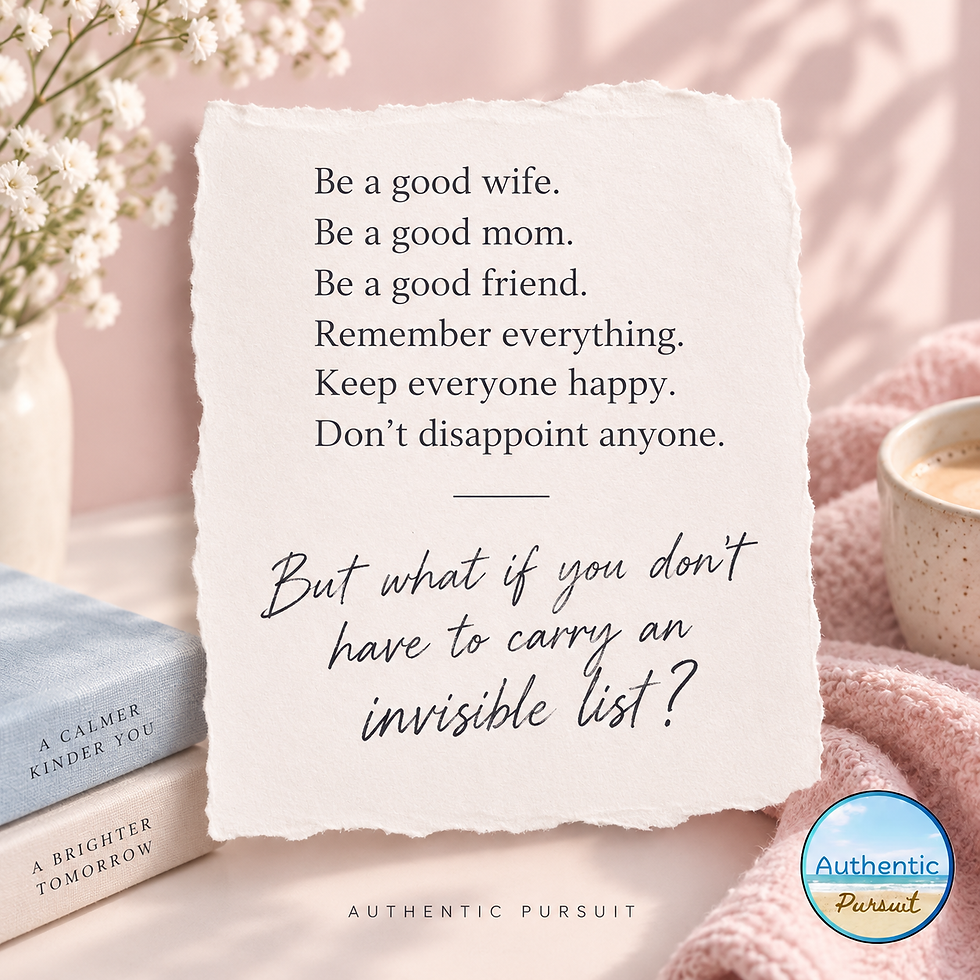
There are absolutely real expectations in life. Marriage has commitment. Parenting has responsibility. Friendship takes effort. Work has demands. Faith has values and practices that matter.
But there is another category I do not think we talk about enough: the expectations nobody actually gave us.
Maybe no one told you dinner had to be homemade every night. Maybe no one said the house had to be perfect before guests came over. Maybe no one said you had to answer every text immediately. Maybe no one told you that if your spouse has a difficult emotion, it is your job to make that emotion disappear.
Sometimes the person holding the clipboard and doing the inspection is us.
And we can be brutal graders.
We create this imaginary version of who we think we are supposed to be. She remembers everything. She never loses her temper. She is patient. Her marriage is connected. Her kids are doing well. She is successful at work, spiritually disciplined, exercising, cooking, keeping up with friendships, serving, volunteering, and apparently drinking a hundred ounces of water every day too.
If you are doing all of that perfectly, I would honestly like to meet you.
But seriously, underneath that image is often a deeper belief: when I finally become like her, then I will finally be enough. Then I will finally be loved.
The problem is that perfectionism always moves the finish line.
There is always one more thing to do, one more person to help, one more room to clean, one more mistake to replay at two o’clock in the morning, one more version of yourself that you think you should have been.
And sometimes the real goal was never excellence. The goal was safety.
If I do everything right, nothing bad will happen. If everyone is happy, nobody will leave. If I anticipate every problem, I will not be blindsided. If I am valuable enough, maybe I will be loved.
Sacrifice and Self Erasure Are Not the Same Thing
Love absolutely involves sacrifice. Parenting does. Marriage does. Friendship does.
There are times when we choose to put someone else’s needs ahead of our own because that is what love asks of us in that moment.
But there is a difference between sacrificing and erasing yourself.
Sacrifice says, “I have a self, and I am choosing to give.”
Self erasure says, “My needs do not matter.”
Those are not the same thing.
That distinction has led me to ask myself some hard questions.
Can I love you and still exist?
Can your feelings matter without becoming my responsibility to regulate?
Can I care about your problem without making it my entire emotional world?
Can I help you without believing I need to rescue you?
Can I say no and still be loving?
Can you be disappointed in me and I still be a good person?
Can I have needs too?
I think those questions get to the heart of what healthy love actually looks like.
Intimacy Requires Being Known
Most of our closest relationships should allow us to be known.
Not just the polished version of us.
Not just the useful version.
Not just the version who organizes everything, remembers everything, fixes everything, and carries everything.
I want the people closest to me to know me. The person who sometimes needs support. The person who has limits. The person who has feelings that are not always convenient. The person who sometimes gets things wrong.
Because what really is intimacy if I only let the people closest to me love the polished version of me?
At that point, it becomes performance.
Intimacy requires being known.
This matters to me as a mom too. I do not want my children to believe that being a good mother means never making a mistake. I want them to see that Mom can apologize. Mom can have a hard day. Mom can rest. Mom can set a boundary. Mom can love them deeply without controlling every outcome.
I do not want to teach them performance. I want to teach them resilience and wholeness.
Am I Helping Because They Need It, or Because I Need Them to Be Okay?
This may be one of the biggest questions I have been asking myself lately.
Am I doing this because they actually need my help, or because I need them to be okay?
Sometimes helping really is helping.
But sometimes helping is how I regulate myself.
If you are okay, I can relax. If you are happy, I can relax. If you are not mad at me, I can relax. If everybody is getting along, I can relax.
At that point, I may not actually be stepping in because you asked me to. I may be stepping in because your discomfort is making me uncomfortable.
That does not make us bad people. It makes us human. But I think it is important to recognize the difference.
Because if my peace depends on controlling the emotional weather around me, I am going to spend my entire life trying to control the weather.
And we all know we cannot do that.
People we love are going to have hard days. They are going to make decisions we do not agree with. Someone will misunderstand us. Someone will be disappointed in us. Someone may even be angry with us.
I cannot build my worth around preventing all of that.
Who Am I When I Am Not Being Useful?
This is another question that has really stayed with me:
Who am I when I am not being useful?
Can I receive care as easily as I give it? Do I know what I need? What do I believe would happen if I stopped doing so much? What would happen inside of me if someone I loved was upset and I did not immediately try to fix it?
And what would wholeness actually look like?
Maybe wholeness looks like loving your family deeply and resting.
Maybe it looks like caring about someone’s feelings without taking responsibility for them.
Maybe it looks like cooking dinner because you want to care for your family, and sometimes ordering pizza because you are exhausted.
Maybe it looks like telling your spouse what you need instead of hoping they notice.
Maybe it looks like admitting, “I do not know.”
Maybe it looks like asking for help.
What Authentic Pursuit Means to Me
This is really what the word authentic means to me.
Authenticity is not saying whatever you want whenever you want. It is not selfishness.
For me, authenticity is congruence. It is bringing the person I am on the inside and the person I show on the outside closer together.
It means I am not smiling while quietly resenting everyone because I said yes to things I did not have the capacity to do. I am not telling everybody I am fine and then wondering why no one is helping me. I am not building relationships where the price of admission is what I can provide.
I am learning to show up honestly, loving, giving, and serving, but also receiving, speaking, resting, needing, and being known.
The goal is not to get rid of every expectation in our lives. Relationships need expectations. Marriage has commitment. Parenting has responsibilities. Friendship requires effort.
The better question is which expectations are actually mine to carry.
Which ones come from my values? Which ones come from my faith? Which ones truly belong to the relationship? And which ones have I written myself because somewhere inside of me I believed I had to earn my place, prove my worth, keep everyone happy, or become perfect?
Maybe today it is worth thinking about the relationship where you are doing the most and asking yourself:
Am I showing up as myself, or am I performing a role?
Am I loving, or am I trying to prove something?
Am I giving freely, or am I trying to earn security?
Am I helping, or am I managing?
Because love is not meant to be a scoreboard.
Our deepest relationships should be the places where we become more known, not less. More authentic, not less.
So maybe the goal is not asking, “How can I become perfect enough to be loved?”
Maybe the better question is:
How can I become whole enough to receive the love that is already being offered?
That is something I am working on too.
Free Self Reflection Resource

If any of this sounds familiar, I created a free Self Reflection Assessment to help you look at patterns like putting other people’s needs before your own, difficulty saying no, worrying about other people’s problems, and losing yourself somewhere in the process of caring for everyone else.
The goal is not to give yourself another score to judge.
It is simply to become more aware and get curious about what you notice.
Get the free resource here:https://www.authenticpursuit.net/challenges
Authentically,
Kristina


Comments